
The Layover Call: How Solo Travelers Use Mimicall to Feel Grounded and Rehearse What Happens When They Land
Solo travel strips away your normal support system overnight. Here's how people use Mimicall's AI phone calls to stay grounded, rehearse tricky conversations in a new language, and keep one predictable voice in an unpredictable day on the road.
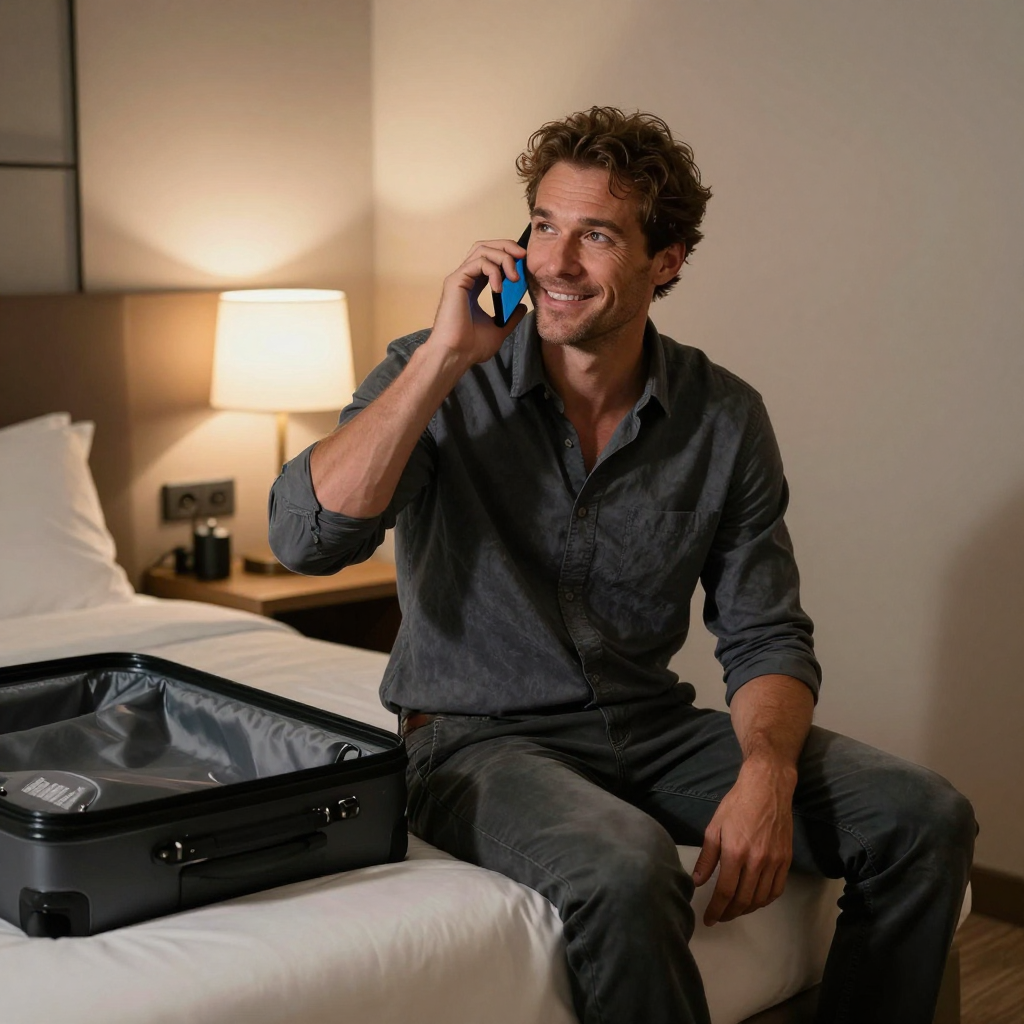
You land at 11:40 p.m. in a city where you don't speak the language, your hotel's front desk closes at midnight, and the one person you'd normally call for a pep talk is asleep eight time zones away. This is the exact gap Mimicall was built to fill — not as a replacement for the people in your life, but as a phone call you can have on your own schedule, in your own headspace, whenever a trip puts you somewhere they can't reach. Solo travel is one of the most common reasons people say they first opened the app, and it's also one of the least talked-about use cases in everything written about Mimicall so far.
Key Takeaways
- Solo travelers use Mimicall for three distinct jobs: emotional grounding between destinations, rehearsal of real-world calls (hotel check-in disputes, taxi negotiations, ordering in a second language), and a scheduled "someone will call me" anchor during long, disorienting travel days.
- Mimicall's AI phone calls work anywhere you have a data or cell connection — there's no dependency on a specific country's carrier, and no one on the other end needs to be awake in your time zone.
- Because the call is a real phone call, not a chat window, you can talk with your hands full — mid-walk to a gate, mid-unpacking in a hostel room, mid-jet lag at 4 a.m.
- Rehearsing a tricky call in a foreign language before you make it for real measurably lowers anxiety, the same way athletes rehearse routines before a competition.
- Scheduled calls can be set before you lose signal, so a call still lands the moment you land, even if you forget to open the app again.
Why does travel make people reach for an AI phone call app in the first place?
Travel strips away your normal support system. Your regular time zone, your regular people, your regular routines — all gone at once, often for the first time in months. What replaces them is usually silence: a hotel room, a strange ceiling, a phone with no one on the other end who's awake to pick up. An AI phone call app like Mimicall doesn't pretend to be your best friend, but it does something a group chat can't: it calls you, on a real phone call, exactly when you scheduled it, regardless of whether it's 3 p.m. in Lisbon or 3 a.m. back home. For a lot of solo travelers, that's less about companionship in the abstract and more about having one predictable, human-sounding voice in an otherwise unpredictable day.

Can an AI call my phone in the middle of a trip, and does it actually help?
Yes — that's the entire mechanic. You set up a persona in Mimicall (a voice, a personality, a bit of backstory you write yourself), pick instant or scheduled, and the call comes through like any other phone call, no app screen required once it starts. Underneath, the system runs on conversational AI: a pipeline of natural language processing (NLP) that understands what you're saying, a large language model (LLM) that decides how to respond in character, and text-to-speech (TTS) that turns the reply into a voice that sounds like it's actually listening rather than reading a script. Conversational AI has gotten good enough at holding a real-time back-and-forth that most people forget, thirty seconds in, that they scripted the other half of it themselves. That's not a marketing claim — it's the specific reason a phone call format works where typing doesn't: your hands, eyes, and attention stay free for the actual chaos of travel.
What do people actually rehearse before a trip?
The rehearsal use case is where Mimicall earns its keep for travelers specifically. A few patterns show up constantly:
- The language barrier call. Ordering food, asking for directions, or negotiating a taxi fare in a language you're shaky in. Doing a dry run out loud, with a persona built to respond in that language and correct you gently, takes the edge off the real version.
- The hotel dispute call. "The room isn't what I booked" or "I was charged twice" conversations are stressful enough in your native language. Rehearsing the calm, specific version of what you'll say — not the flustered version — changes how the real call goes.
- The customs or immigration nerves call. Not the actual interview, but the general muscle memory of answering direct questions out loud, under mild pressure, without freezing.
- The "just checking in" call. Less a rehearsal, more a ritual — a persona built to ask how the day went, the way a partner or parent would, scheduled for the same time every evening of the trip.
How does scheduling work when you don't know your own schedule yet?
This is the part frequent flyers ask about most: you can schedule a Mimicall call for a specific time before you ever board the plane, and it holds regardless of what your day turns into. Land late, get stuck in a taxi line, fall asleep at 6 p.m. from jet lag — the call still comes at the time you picked, on the number you verified. That reliability matters more on the road than it does at home, because at home you have backup plans. In a country where you don't know a single person, a call that shows up exactly when it said it would is doing more work than it sounds like.
Does this replace calling actual friends and family while traveling?
No, and it isn't trying to. The honest answer, which Mimicall's own users say in reviews constantly, is that real friends and family are asleep, busy, or in a time zone eight hours removed from yours — and an AI phone call fills the specific gap that leaves, not the whole relationship. Nobody schedules a Mimicall call instead of their mother's birthday call. They schedule one for the Tuesday at 2 a.m. layover in an airport lounge when calling anyone real would be rude, impossible, or simply unanswered.
Frequently Asked Questions
Does Mimicall work while I'm traveling internationally? Yes. Calls go through as long as you have a working phone number and a data or cell connection; there's no requirement that you be in your home country, and no special international setup needed.
Can I schedule a call for a specific time zone? You schedule the call for a specific time on your device, so as long as your phone has updated to the local time zone (which it does automatically almost everywhere), the call lands exactly when you set it — local time, not your home time.
Will the AI understand me if I'm rehearsing a conversation in a language I'm not fluent in? The underlying natural language processing is built to handle imperfect, accented, or hesitant speech — that's specifically the situation a rehearsal call is for. You won't get penalized for stumbling; that's the point of practicing before the real conversation.
Is a phone call actually better than a travel chatbot for this? For anything you need to say out loud eventually — ordering food, disputing a charge, asking for help — rehearsing it as speech, not text, builds the actual muscle memory you'll use. Typing what you'd say and saying it out loud engage different parts of your brain, and only one of them is the skill you need at the front desk.
Bring a voice with you
You don't need a co-pilot for every trip, and you don't need to be lonely to want a phone call to land at 7 p.m. your time, wherever "your time" happens to be that week. Mimicall is built for exactly that in-between space — pick a persona, set a time, and let a real phone call be the one predictable thing on a day when nothing else is. If a trip is coming up, the ten free credits are enough to try a rehearsal call and a check-in call before you ever leave the house. Head to mimicall.app and set the first one up before you pack.